
Welcome back to Cycle Literacy, where we learn to read the language of our bodies.
Have you ever noticed that in the days before your period you sleep a little hotter, kick off the duvet in the middle of the night or feel warmer than usual? It’s not your imagination. Your body temperature follows your cycle, and once you know how to read it, it can tell you something quite beautiful: whether, and when, you ovulated.

The tiny shift after ovulation
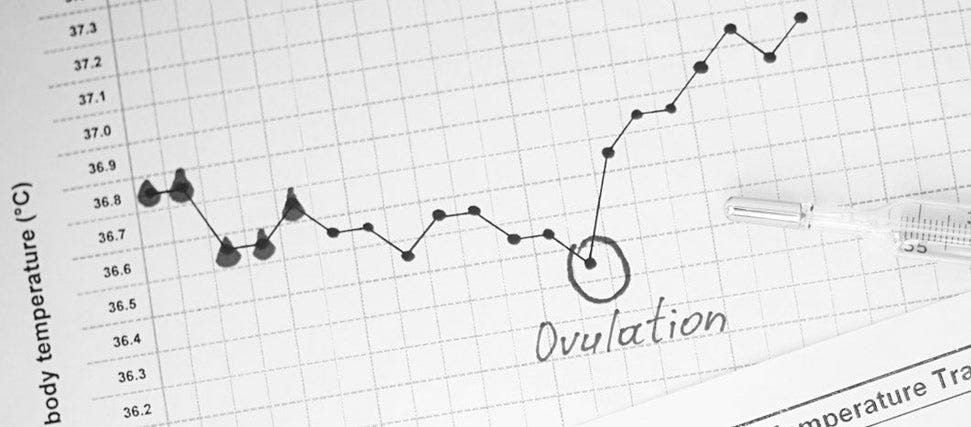
In the first half of your cycle, the follicular phase, your resting body temperature stays at a relatively lower level. Then you ovulate. The follicle that released the egg turns into the corpus luteum, a small temporary gland that starts producing progesterone.
Progesterone has many jobs. It prepares the lining of your uterus for a possible pregnancy, it has a calming effect on the nervous system, and it gently raises your body temperature. After ovulation, your resting temperature typically rises by about 0.3 to 0.6°C, and it stays higher for the rest of the luteal phase, until progesterone falls again and your period begins.
It’s a very small shift, far too small to feel with your hand on your forehead. But measured carefully, it’s one of the clearest signals your body gives you.
What your temperature can tell you
When you track your temperature every morning, you’ll start to see two levels in your chart: a lower one before ovulation and a higher one after. That pattern tells you a few things:
That you ovulated. A clear, sustained rise is a sign that ovulation has happened and your body is producing progesterone. And ovulation isn’t only about fertility. It’s how your body makes progesterone at all, which matters for your mood, your sleep and your bones.
How long your luteal phase is. Counting the days from the temperature rise to your period gives you a sense of your luteal phase. In general, a luteal phase of around 10 to 16 days is considered healthy. A very short one is worth discussing with a doctor.
Why you feel the way you do. If you sleep worse, feel warmer or get hungrier in the second half of your cycle, your chart helps you see that it’s part of a rhythm, not a random bad week.
One honest limitation: your temperature only confirms ovulation after it has happened. It can’t predict it. That’s why, if you’re using cycle tracking to avoid or plan a pregnancy, temperature is usually combined with other signs, like your cervical mucus, and ideally learned with a trained instructor.
How to take your basal temperature
Your basal body temperature is your temperature at complete rest. To measure it well:
Use a basal thermometer that measures to two decimals (for example 36.45°C).
Measure as soon as you wake up, for 3 minutes, before you sit up, talk, drink or check your phone. Keep the thermometer on your bedside table.
Measure around the same time every day, and ideally after at least three to four hours of sleep.
Write it down, on paper or in an app, and note anything unusual: a late night, alcohol, a cold, travel or a bad night’s sleep. All of these can shift your reading.
Don’t expect a perfect line. Real charts are a little bumpy. What you’re looking for is the overall pattern: lower, then a clear step up that holds for at least three days.

When you’re cold all month long
Some women notice something else when they start tracking: their temperature is low across the whole cycle, and they’re also the ones with ice-cold hands and feet, all year round.
This can have many causes, and some are completely harmless. But a few are worth checking. Low iron, which is common in women with heavy periods, can leave you cold and tired. An underactive thyroid can slow down your metabolism and make you feel cold, sluggish and foggy. And eating too little for a long time can make your body turn the heat down to save energy, sometimes alongside irregular or missing periods.
What Ray Peat saw in a thermometer
Most cycle-tracking guides stop at ovulation. But for some researchers, your morning thermometer was telling a much bigger story: how well your whole metabolism is running.
In the 1940s, an American doctor called Broda Barnes noticed that many of his patients with classic signs of an underactive thyroid, like tiredness, cold hands and feet, dry skin and heavy or irregular periods, had consistently low morning temperatures, even when their other tests looked normal. He developed a simple test: measure your underarm temperature first thing in the morning, before getting up, for several days in a row. In his view, readings consistently below about 36.6°C could point to a sluggish thyroid.
The biologist Ray Peat, whose work has deeply shaped the way I think about nutrition, built on Barnes’s ideas. For Peat, temperature and pulse together were among the most honest signs of how your metabolism is doing. He suggested that in a healthy person, the waking temperature should be close to 36.7°C and rise to around 37°C by mid-morning, and that a resting pulse of about 85 beats per minute is typical of a well-functioning metabolism. That’s higher than the very low resting heart rates we often celebrate today, and it’s one of the places where his thinking goes against the grain.
He also believed that stress hormones can hide a low metabolism. When blood sugar drops, the body releases adrenaline, which can push your temperature and pulse up for a while. That’s why he paid attention to what happens after eating: in his view, a well-nourished body with a healthy thyroid warms up after breakfast, while a struggling one doesn’t, or even cools down. If you read Monday’s Daily Bread, you’ll recognise this. It’s exactly the little experiment I invited you to try.
And this is where it all comes back to your cycle. Your thyroid and your reproductive hormones work closely together. A body that’s warm, well fed and not chronically stressed is a body that feels safe enough to ovulate and make plenty of progesterone. A body that’s cold and running in survival mode often can’t. Many fertility-awareness teachers see this pattern in women’s charts: low temperatures across the whole cycle, a weak temperature rise after ovulation and a short luteal phase.

Holding it with care
I find this way of thinking incredibly empowering, because it gives women a simple, daily way to listen to their bodies. Barnes’s test and Peat’s numbers, however, are not how thyroid problems are officially diagnosed today, and they haven’t been confirmed in large modern studies. Your temperature is affected by many things: sleep, alcohol, illness, stress, the room you sleep in, hormonal contraception and, of course, your cycle itself. If you want to look at your thyroid, the best days to compare are the first days of your period, before progesterone rises again.
So use your thermometer as a conversation starter, not a diagnosis. If your temperatures are low and you recognise the symptoms, ask your doctor for a full thyroid panel, not only TSH but also free T4, free T3 and ideally thyroid antibodies, and bring your chart along.
This week’s practice
If you’ve never tracked your temperature, this is a lovely week to start. Buy a basal thermometer, put it next to your bed and simply begin. Don’t worry about interpreting anything yet. After one or two full cycles, you’ll start to recognise your own pattern, and that’s when it gets interesting.
And if you’re curious about your metabolism, add one small thing: take your pulse too. Count it for a full minute while you’re still lying in bed, and again about an hour after a warm breakfast. Write both down next to your temperature and see what story they tell together.
Your body is talking all the time. Sometimes it whispers in fractions of a degree. :)
With love, Ninalotte
Do you track your temperature? Tell me in the comments what you’ve learned from it.
Sources: